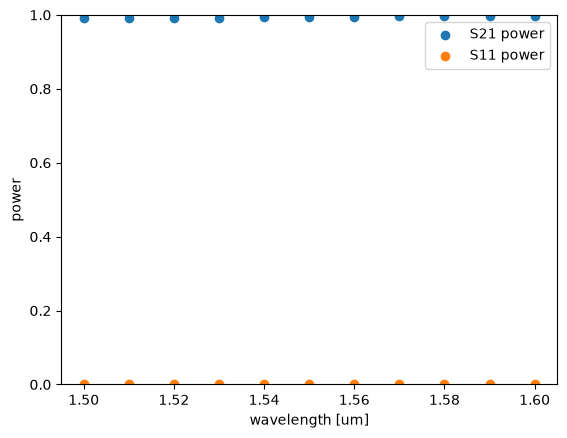
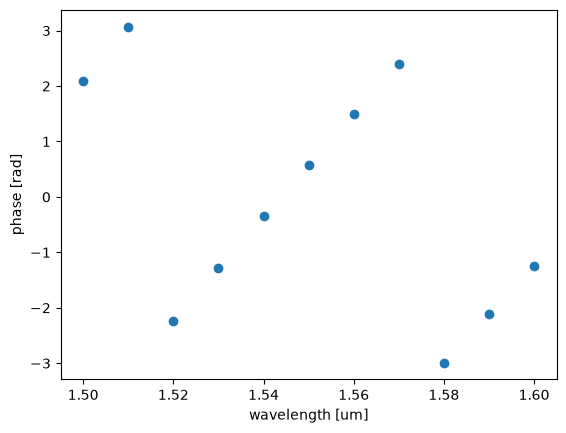
Wavelength dependent S-parameters for Euler waveguide bend in SOI
Setup
import os
import numpy as np
import matplotlib.pyplot as plt

import gdsfactory as gf
from gdsfactory.technology import LogicalLayer, LayerLevel, LayerStack
import luminescent as lumi

# simulation folder
path = os.path.join("runs", "bend")

# dims [um]
# length units are arbitrary so long as they're consistent
r=5
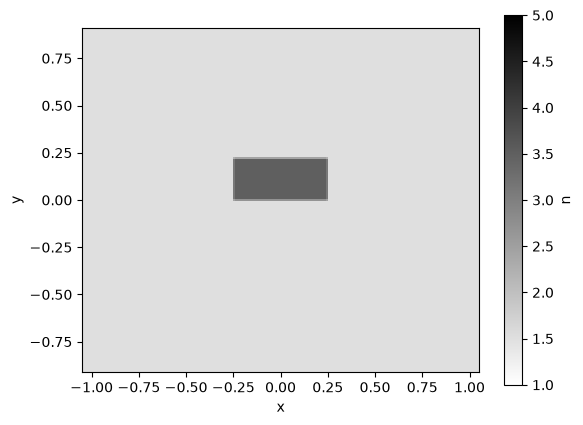
w_wg = 0.5
h_wg = 0.22
bend_type = "euler"

# wavelengths [um].
# spectrum computed from single FDTD run. more wavelengths slightly increases runtime
wavelength = 1.55
bandwidth = 0.1
nwls = 11
wavelengths = np.linspace(wavelength - bandwidth / 2, wavelength + bandwidth / 2, nwls)

# "euler" or "circular"
def setup(path,wavelength,wavelengths, r,w_wg,h_wg,bend_type):
    # simulation parameters
    nres = 6
    subpixel_smoothing = 1
    shutoff = 1e-3
    tmax = 100
    PML_decay = [0.001, 0.001, 0.1]  # x y z
    views = [lumi.view("Hz", y="half", z=0)]
    shot_every = 10 # movie [periods]

    boundaries = ["PML", "PML", "PML"]

    # margins
    margin = 0.8
    source_offset = 1

    # vertical dims
    zmargin = 0.8
    zmin = -h_wg / 2 - zmargin
    zmax = h_wg / 2 + zmargin

    # materials
    core = "Si"
    clad = "SiO2"
    materials = {
        "Si": lumi.material(3.5),
        "SiO2": lumi.material(1.5),
    }
    background = clad

    # layers
    WG = 1, 0
    CLAD = 2, 0

    layer_stack =     LayerStack(
            layers={
                "core": LayerLevel(
                    layer=LogicalLayer(layer=WG),
                    thickness=h_wg,
                    zmin=-h_wg / 2,
                    material=core,
                    mesh_order=1,
                )
            }
        )

    # make component in gdsfactory. alternatively can import .gds into gdsfactory
    c = gf.Component()

    # Euler or circular bend
    if bend_type == "euler":
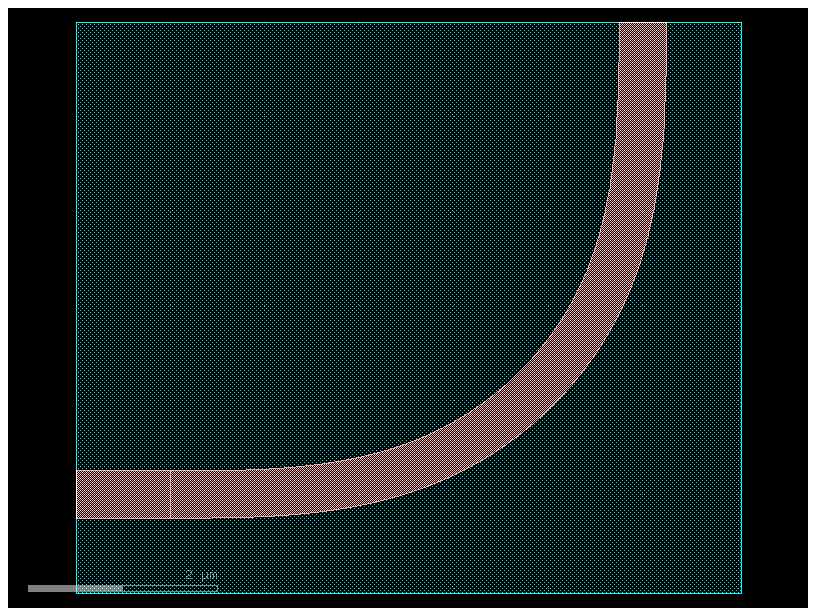
        b = c << gf.components.bend_euler(r)
    elif bend_type == "circular":
        b = c << gf.components.bend_circular(r)
    s = c << gf.components.straight(length=source_offset, width=w_wg)

    s.connect("o2", b.ports["o1"])
    c << gf.components.bbox(component=c, layer=CLAD, right=margin, bottom=margin)

    c.add_port("o1", port=b.ports["o1"])
    c.add_port("o2", port=b.ports["o2"])
    c.plot()

    bbox = c.bbox_np().tolist()
    bbox[0].append(zmin)
    bbox[1].append(zmax)

    # sources, monitors
    w_port = w_wg + 2 * margin
    frames = [
        lumi.plane_frame(
            "wg_mode",
            start=[-w_port / 2, zmin],
            stop=[w_port / 2, zmax],
            boundaries=["PML", "PML"],
            nmodes=1,
            modes="auto",
            wls_mode_solver=[wavelength],
        ),
        lumi.points_frame("wg_signal", points=[[0, 0]], time_domain=True),
    ]

    sources = [
        lumi.gf_source(
            "o1", c, layer_stack, source_offset,
            frame="wg_mode",
            wl=wavelength,
            bandwidth=max(max(wavelengths) - min(wavelengths), wavelength / 8),
        )
    ]

    monitors = [
        # modal monitors
        lumi.gf_monitor(
            "o1", c, layer_stack,
            frame="wg_mode",
        ),
        lumi.gf_monitor(
            "o2", c, layer_stack,
            frame="wg_mode",
            mirrored=True,
        ),
        # time traces (not necessary for S-parameters but for visualizing the signal)
        # lumi.gf_monitor("o2", c, layer_stack, name="o2_signal", frame="wg_signal"),
    ]

    # writes .obj mesh files from gdsfactory component
    lumi.mesh(path, c, layer_stack, materials, zmin, zmax)

    # writes setup file
    lumi.setup(
        path=path,
        wl=wavelength,
        wls=wavelengths,
        materials=materials,
        background=background,
        boundaries=boundaries,
        bbox=bbox,
        #
        frames=frames,
        sources=sources,
        monitors=monitors,
        #
        nres=nres,
        subpixel_smoothing=subpixel_smoothing,
        tmax=tmax,
        PML_decay=PML_decay,
        #
        views=views,
        shot_every=shot_every,
        shutoff=shutoff,
    )

setup(path, wavelength, wavelengths, r, w_wg, h_wg,bend_type)
lumi backend: ~/Luminescent/bin/lumi
using simulation folder runs/bend
Solve
lumi.solve(path)========================================
backend using simulation folder runs/bend
========================================
setting up simulation...
processing geometry bodies...
generating voxels...
voxelation: 4.115972 seconds (53.76 M allocations: 2.229 GiB, 9.59% gc time, 391.77% compilation time: <1% of which was recompilation)
Yee mode λ=1.0: neff 2.5056
making sources o1 ...
making monitors o1 o2 ...
========================================
run: runs/bend
processor: GPU
cpu threads: 48
nres: 6.0
courant: 0.9
subpixel_smoothing: 1
boundaries: [:PML :PML; :PML :PML; :PML :PML]
sources
o1: -1, 0.0, -0.11
monitors
o1: 0, 0, -0.11
o2: 5, 5, -0.11
original size: (92, 83, 20)
padded size: (129, 121, 34)
cell count: 530,706
step size: 28.0 steps/period
source duration: 3.93 periods
max time: 100.0 periods
max steps: 2,800
max load: 1,485,976,800 cell-steps
energy decay threshold: 0.001
========================================
running simulation...
accumulating dft field...
period 10, decay: 0.98, 1.18 seconds/period, 12.65 Mcells/s
period 20, decay: 0.96, 0.004 seconds/period, 3871.04 Mcells/s
period 30.0, decay: 0.48, 0.003 seconds/period, 4383.56 Mcells/s
period 36.57 stop on energy decay
3548.12 Mcells/s
simulation completed.
Movie
lumi.movie(path)Loading...
Results
sol = lumi.load(path)
o1 = sol["monitors"]["o1"]
o2 = sol["monitors"]["o2"]

# + denotes forward propagating mode (wrt port monitor normal)
S21 = o2["modes"][0]["+"] / o1["modes"][0]["-"]
S11 = o1["modes"][0]["+"] / o1["modes"][0]["-"]

mid=nwls//2
S21_=np.abs(S21[mid])**2
S11_=np.abs(S11[mid])**2
print("S21 power 1.55um:", S21_)
print("S11 power 1.55um:", S11_)
assert S21_>.983
assert S11_<.0025

plt.figure()
plt.scatter(wavelengths, np.abs(S21)**2, label="S21 power")
plt.scatter(wavelengths, np.abs(S11)**2, label="S11 power")
plt.xlabel("wavelength [um]")
plt.ylabel("power")
plt.ylim(0, 1)
plt.legend()
plt.show()

plt.figure()
plt.scatter(wavelengths, np.angle(S21), label="S21 phase")
plt.xlabel("wavelength [um]")
plt.ylabel("phase [rad]")
plt.show()
loading solution from runs/bend
may take a minute if simulation folder is remotely mounted
S21 power 1.55um: 0.9941762210482592
S11 power 1.55um: 0.0010443088640080581