Micro-ring resonator on silicon-on-insulator (SOI). Compare with Lumerical example: our results appear more accurate (higher Q and no splitting artifact) and run faster
Parameters
import os
import numpy as np
import matplotlib.pyplot as plt

import gdsfactory as gf
from gdsfactory.technology import LogicalLayer, LayerLevel, LayerStack
import luminescent as lumi

# simulation folder
path = os.path.join("runs", "ring")

# length units are arbitrary so long as they are consistent, in this case [um]. everything gets normalized around origin wavelength and period at backend.
wavelength = 1.55  # characteristic wavelength [um]
bandwidth = 0.1  # wavelength bandwidth [um]
wavelengths = np.linspace(wavelength - bandwidth / 2, wavelength + bandwidth / 2, 401)

# horizontal dims
r = 3.1  # radius of ring
w_wg = 0.4  # width of waveguide
gap = 0.1  # gap between waveguide and ring

# vertical dims
h_wg = 0.18  # height of waveguide

def setup(path,r,gap,w_wg,h_wg):
    # simulation parameters
    nres = 8  # number of grid points per wavelength in material (not vacuum)
    shutoff = 0.001
    courant = 0.95  # Courant factor for time step size, relative to max allowed by grid
    subpixel_smoothing = 1
    PML_decay = [.001,.1,.1]
    tmax = 3000  # max time [periods]
    shot_every = 50  # save and plot field every _ periods, involves slow disk write
    views = [lumi.view("Hz", x=0, z=0)]

    boundaries = ['PML', 'PML', 'PML']

    # margins
    source_offset = 2
    margin = 1

    # vertical dims
    zmargin = height_port_margin = 1
    zmin = -h_wg / 2 - zmargin
    zmax = h_wg / 2 + zmargin

    # materials
    core = 'Si'
    clad = 'SiO2'
    background = clad
    nSi = 3.5
    nSiO2 = 1.5
    materials = {
        'Si': lumi.material(nSi),
        'SiO2': lumi.material(nSiO2),
    }

    # layer stack
    WG = (1, 0)  # waveguide layer
    BBOX = (10, 0)  # bounding box layer
    layer_stack = LayerStack(
        layers={
            'core': LayerLevel(
                layer=LogicalLayer(layer=WG),
                thickness=h_wg,
                zmin=-h_wg / 2,
                material=core,
                mesh_order=1,
            )    })

    ## Geometry
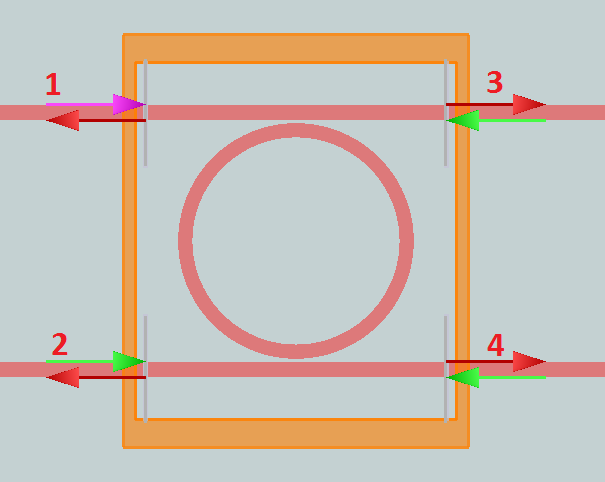
    # add-drop ring: input o1, drop o2, through o3, add o4
    # make component in gdsfactory. alternatively, you can import .gds layout into gdsfactory or .stl bodies directly into ours
    c = gf.Component()

    c << gf.components.ring(radius=r, width=w_wg, layer=WG)

    l = 2 * r + 2 * margin + w_wg
    # s = c << gf.components.straight(length=l - source_offset, width=w_wg)
    # s.move((-l / 2 + source_offset, w_wg + gap + r))

    # s1 = c << gf.components.straight(length=source_offset, width=w_wg)
    # s1.connect('o2', s.ports['o1'])

    # top waveguide: one straight, extended by source_offset on left for source
    y_top = w_wg + gap + r
    s = c << gf.components.straight(length=l + source_offset, width=w_wg)
    s.move((-l / 2 - source_offset, y_top))

    # s2 = c << gf.components.straight(length=l, width=w_wg)
    # s2.move((-l / 2, -(w_wg + gap + r)))
    # bottom waveguide: same extent as top so both ends reach bbox edge
    s2 = c << gf.components.straight(length=l + source_offset, width=w_wg)
    s2.move((-l / 2 - source_offset, -y_top))

    # c.add_port('o1', port=s.ports['o1'])
    c.add_port('o1', center=(-l / 2, y_top), width=w_wg, orientation=180, layer=WG)  # margin from ring edge
    # c.add_port('o2', port=s2.ports['o1'])
    c.add_port('o2', center=(-l / 2, -y_top), width=w_wg, orientation=180, layer=WG)
    c.add_port('o3', port=s.ports['o2'])
    c.add_port('o4', port=s2.ports['o2'])
    c << gf.components.bbox(component=c, layer=BBOX, top=margin, bottom=margin)
    c.plot()

    bbox = c.bbox_np().tolist()
    bbox[0].append(zmin)
    bbox[1].append(zmax)

    # source and modes setup
    w_port = w_wg + 2 * margin

    frames = [
        lumi.plane_frame('mode', wls_mode_solver=[wavelength], start=[-w_port / 2, zmin], stop=[w_port / 2, zmax], boundaries=['PML', 'PML'], nmodes=1),  # local xy basis
        lumi.points_frame('trace', points=[[0,0]], time_domain=True),
    ]

    sources = [lumi.gf_source('o1', c, layer_stack, source_offset, frame='mode', wl=wavelength, bandwidth=max(max(wavelengths) - min(wavelengths), wavelength / 8))]

    monitors = [
        lumi.gf_monitor('o1', c, layer_stack, frame='mode'),
        lumi.gf_monitor('o2', c, layer_stack, frame='mode'),
        lumi.gf_monitor('o3', c, layer_stack, frame='mode', mirrored=True),
        lumi.gf_monitor('o1', c, layer_stack, frame='trace', name='u1')
    ]

    lumi.mesh(path, c, layer_stack, materials, zmin, zmax)
    lumi.setup(
        path=path,
        wl=wavelength,
        wls=wavelengths,
        materials=materials,
        background=background,
        boundaries=boundaries,
        bbox=bbox,
        #
        frames=frames,
        sources=sources,
        monitors=monitors,
        #
        nres=nres,
        courant=courant,
        subpixel_smoothing=subpixel_smoothing,
        tmax=tmax,
        PML_decay=PML_decay,
        #
        views=views,
        shot_every=shot_every,
        shutoff=shutoff,

    )

setup(path,r,gap,w_wg,h_wg)
Mesh is not watertight; plotting debug view
Warning: boolean difference failed at index 1: Not all meshes are volumes!
Warning: boolean difference failed at index 2: Not all meshes are volumes!
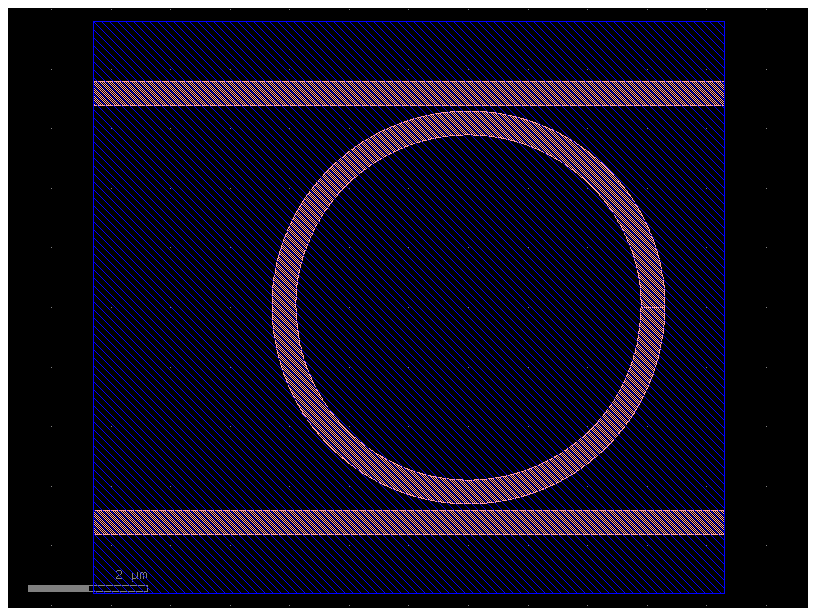
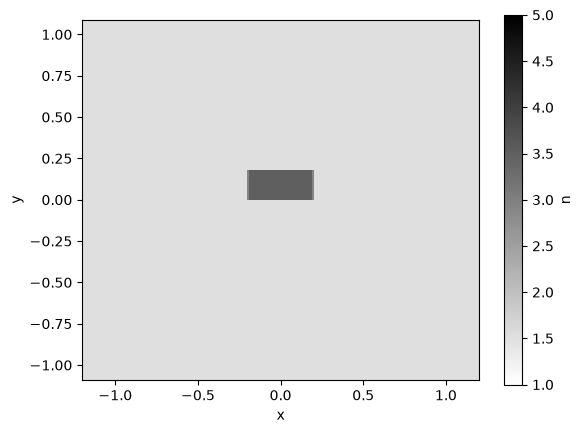
using simulation folder runs/ring
Solve
lumi.solve(path)========================================
backend using simulation folder runs/ring
========================================
setting up simulation...
processing geometry bodies...
generating voxels...
voxelation: 6.531373 seconds (219.61 M allocations: 8.293 GiB, 23.04% gc time, 293.85% compilation time)
Yee mode λ=1.0: neff 2.1167
making sources o1 ...
making monitors o1 o2 o3 u1 ...
========================================
run: runs/ring
processor: GPU
cpu threads: 48
nres: 8.0
courant: 0.95
subpixel_smoothing: 1
boundaries: [:PML :PML; :PML :PML; :PML :PML]
sources
o1: -6.3, 3.6, -0.09
monitors
o1: -4.3, 3.6, -0.09
o2: -4.3, -3.6, -0.09
o3: 4.3, 3.6, -0.09
u1: -4.3, 3.6, -0.09
original size: (194, 166, 33)
padded size: (262, 184, 54)
cell count: 2,603,232
step size: 54.0 steps/period
source duration: 3.94 periods
max time: 3,000 periods
max steps: 162,000
max load: 421,723,584,000 cell-steps
energy decay threshold: 0.001
========================================
running simulation...
accumulating dft field...
period 50, decay: 0.183, 0.269 seconds/period, 522.38 Mcells/s
period 100, decay: 0.07, 0.019 seconds/period, 7468.03 Mcells/s
period 150, decay: 0.04, 0.019 seconds/period, 7376.83 Mcells/s
period 200, decay: 0.027, 0.019 seconds/period, 7484.13 Mcells/s
period 250, decay: 0.019, 0.019 seconds/period, 7547.68 Mcells/s
period 300, decay: 0.015, 0.019 seconds/period, 7535.52 Mcells/s
period 350, decay: 0.012, 0.019 seconds/period, 7523.43 Mcells/s
period 400, decay: 0.01, 0.019 seconds/period, 7528.83 Mcells/s
period 450, decay: 0.008, 0.019 seconds/period, 7498.44 Mcells/s
period 500, decay: 0.007, 0.019 seconds/period, 7568.06 Mcells/s
period 550, decay: 0.006, 0.019 seconds/period, 7555.64 Mcells/s
period 600, decay: 0.005, 0.019 seconds/period, 7571.2 Mcells/s
period 650, decay: 0.004, 0.018 seconds/period, 7707.49 Mcells/s
period 700, decay: 0.004, 0.019 seconds/period, 7519.1 Mcells/s
period 750, decay: 0.004, 0.019 seconds/period, 7501.05 Mcells/s
period 800, decay: 0.003, 0.019 seconds/period, 7527.1 Mcells/s
period 850, decay: 0.003, 0.019 seconds/period, 7549.73 Mcells/s
period 900, decay: 0.002, 0.019 seconds/period, 7547.48 Mcells/s
period 950, decay: 0.002, 0.019 seconds/period, 7548.24 Mcells/s
period 1,000, decay: 0.002, 0.019 seconds/period, 7532.01 Mcells/s
period 1,050, decay: 0.002, 0.019 seconds/period, 7528.37 Mcells/s
period 1,100, decay: 0.002, 0.019 seconds/period, 7526.38 Mcells/s
period 1,150, decay: 0.002, 0.019 seconds/period, 7494.78 Mcells/s
period 1,200, decay: 0.001, 0.019 seconds/period, 7484.88 Mcells/s
period 1,250, decay: 0.001, 0.019 seconds/period, 7473.42 Mcells/s
period 1,300, decay: 0.001, 0.019 seconds/period, 7462.43 Mcells/s
period 1,350, decay: 0.001, 0.019 seconds/period, 7464.05 Mcells/s
period 1,400, decay: 0.001, 0.019 seconds/period, 7465.49 Mcells/s
period 1410.37 stop on energy decay
7514.71 Mcells/s
simulation completed.
Movie
lumi.movie(path)Loading...
Results
S parameters
sol = lumi.load(path)
o1=sol['monitors']['o1']
o2=sol['monitors']['o2']
o3=sol['monitors']['o3']

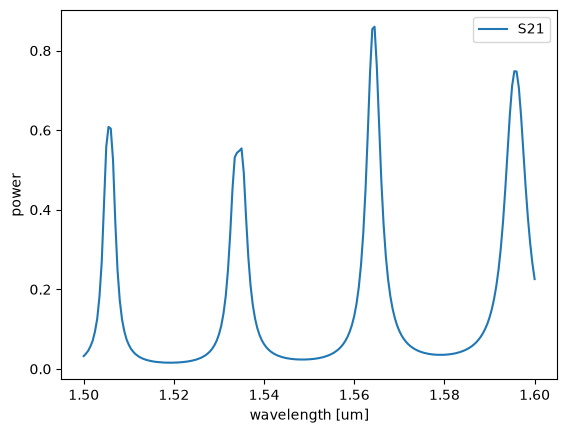
S21 = o2['modes'][0]['+'] / o1['modes'][0]['-'] # drop port
S31 = o3['modes'][0]['+'] / o1['modes'][0]['-'] # through port

plt.plot(wavelengths, np.abs(S21)**2, label="S21")
# plt.plot(wavelengths, S31, label="S31")

plt.xlabel("wavelength [um]")
plt.ylabel("power")
plt.legend()
plt.show()
loading solution from runs/ring
may take a minute if simulation folder is remotely mounted
Resonances
from scipy.signal import find_peaks

dw=bandwidth/len(wavelengths)
I, props = find_peaks(np.abs(S21), height=0.4, distance=.01//dw)

peaks = wavelengths[I]
print(f'Peaks: {", ".join(f"{1000*x:.2f}nm" for x in peaks)}')
Peaks: 1505.50nm, 1535.00nm, 1564.50nm, 1595.50nm
FSR
FSR = np.mean(np.diff(peaks))
print(f'FSR: {1000*FSR:.2f}nm')
FSR: 30.00nm
Q factor (FWHM method)
i=len(I)//2
mid = I[i]
y=np.abs(S21)**2   # power: FWHM is the half-power (-3 dB) width
half = y[mid]/2

l = mid
while y[l] > half: l -= 1
wl_lo = np.interp(half, [y[l], y[l+1]], [wavelengths[l], wavelengths[l+1]])

r = mid
while y[r] > half: r += 1
wl_hi = np.interp(half, [y[r], y[r-1]], [wavelengths[r], wavelengths[r-1]])  # np.interp needs increasing y

FWHM = wl_hi - wl_lo
wl=wavelengths[mid]
Q=wl/FWHM
print(f'FWHM: {1000*FWHM:.2f}nm\nQ factor (FWHM method): {Q:.0f}')
FWHM: 3.80nm
Q factor (FWHM method): 412
Early stopping (optional)
Can still get FSR and Q factor by stopping early. Saves time because high Q cavity takes long time to decay completely. Instead simulate for only long enough for resonances to settle into decay trend. Here, can set shutoff=0.1
Stopping early in time domain convolves sinc blur in frequency domain. Can still extract resonances and FSR from blurred spectrum, but Q factor must be computed from time domain decay signal.
Q factor (time domain decay method)
t = np.array(sol['t'])
y = np.array(sol['monitors']['u1']['fields']['Ex'][0,:])
t = t[:len(y)]

# zero transients before t0, leaving only ring decay:
# the source pulse peaks at the monitor, then takes ~its duration (~4 periods here) to pass
t0 = t[np.argmax(np.abs(y))] + 4
i = np.searchsorted(t, t0)
y[:i] = 0

plt.plot(t, y)
plt.xlabel("t [period]")
plt.ylabel("u1 Ex (monitor basis of reference)")
plt.show()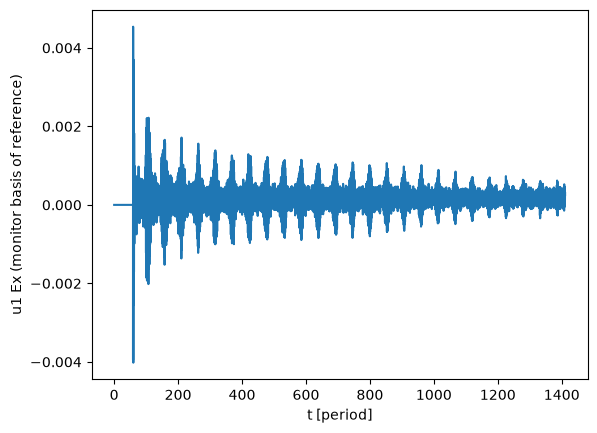
import subprocess

# harmonic inversion of the ringdown (needs harminv: sudo apt install harminv)
# time is in periods of `wavelength`, so frequency f = wavelength / λ
fmin, fmax = wavelength / wavelengths[-1], wavelength / wavelengths[0]
dt = t[1] - t[0]
out = subprocess.run(["harminv", "-t", str(dt), f"{fmin}-{fmax}"],
                     input="\n".join(map(str, y[i:])), capture_output=True, text=True).stdout

# columns: frequency, decay constant, Q, |amplitude|, phase, error
for line in out.splitlines()[1:]:
    f, decay, Q, amp, phase, err = map(float, line.split(","))
    if fmin <= f <= fmax:
        print(f"{1000 * wavelength / f:.2f}nm   Q = {Q:.0f}   |amp| = {amp:.2g}   error = {err:.1e}")
1596.20nm   Q = 341   |amp| = 0.00033   error = 1.4e-06
1595.19nm   Q = 337   |amp| = 0.0004   error = 2.0e-06
1577.95nm   Q = 476   |amp| = 6.9e-07   error = 1.1e-03
1564.81nm   Q = 486   |amp| = 0.00016   error = 2.0e-06
1534.53nm   Q = 664   |amp| = 0.00015   error = 3.0e-07
1506.17nm   Q = 807   |amp| = 8e-05   error = 2.5e-06
1505.16nm   Q = 797   |amp| = 0.00012   error = 2.5e-06
1501.11nm   Q = 232   |amp| = 9.5e-06   error = 3.3e-05