Benchmarks Luminescent against Tidy3D and Lumerical FDTD using the 2×2 MMI from Liu & Poon, arXiv:2506.16665, Sec. 3.3. The device is GDSFactory’s generic mmi2x2_with_sbend: 500 nm × 220 nm Si arms tapered to 700 nm before the multimode region, with S-bends at all four ports. SiO2 cladding is above and below. Si uses a lossless Lorentzian fit to the paper’s Palik model (n = 3.4729 at 1550 nm); SiO2 is constant n = 1.4425. The domain is the device plus 1 µm margins: 34 × 7 × 2.22 µm³ (the paper uses 34 × 7.5 × 4 µm³). TE0 enters o1 (lower left) at 1550 nm with a λ/12 source bandwidth (the paper uses 20 nm). The energy shutoff is 1e-4 (1e-3 for nres ≤ 10; the paper uses 1e-5). We report the cross-port (o3) transmission, the excess loss, the solve time, and the peak memory against resolution.
Paper values (Tidy3D 2.7.7 on cloud GPUs, Lumerical 2025 R1 on a 24-core CPU; transmission digitized from Fig. 12a):
| nres | Tidy3D cross T | Lumerical cross T | Tidy3D time | Lumerical time | Lumerical memory |
|---|---|---|---|---|---|
| 6 | 35.8 % | 37.6 % | 11 s | 98 s | 0.32 GB |
| 10 | 46.1 % | 45.9 % | 34 s | 259 s | 0.82 GB |
| 15 | 47.9 % | 48.3 % | 45 s | 905 s | 2.15 GB |
| 20 | 48.5 % | 48.7 % | 57 s | 2182 s | 4.48 GB |
| 25 | 48.9 % | 48.9 % | 150 s | 4813 s | 8.10 GB |
Setup
import os, time, json, threading, subprocess
import numpy as np
import psutil
import matplotlib.pyplot as plt

import gdsfactory as gf
from gdsfactory.technology import LogicalLayer, LayerLevel, LayerStack
import luminescent as lumi

gf.gpdk.PDK.activate()

nres_list = [6, 10, 15]
h_wg = 0.22
wavelength = 1.55
# bandwidth = wavelength / 4
bandwidth = wavelength / 12
wavelengths = np.linspace(1.54, 1.56, 21).tolist()

# domain margins [um]
margin = 1
zmargin = 1
zmin, zmax = -zmargin, h_wg + zmargin
lumi backend: ~/Luminescent/bin/lumi
def setup(path, nres):
    # Si: lossless single-Lorentzian fit to the paper's Palik model (frequency in units of c / wavelength); SiO2: constant
    materials = {
        "Si": lumi.material(n=3.4729, epsilon=8.36218, dispersion=[lumi.lorentzian(3.0, 0, 3.2882)]),
        "SiO2": lumi.material(1.4425),
    }
    WG = 1, 0
    layer_stack = LayerStack(
        layers={
            "core": LayerLevel(
                layer=LogicalLayer(layer=WG),
                thickness=h_wg,
                zmin=0,
                material="Si",
                mesh_order=0,
            ),
        }
    )

    # GDSFactory generic 2x2 MMI with S-bends
    dc = gf.components.mmi2x2_with_sbend()
    xmin, ymin = dc.bbox_np()[0]
    xmax, ymax = dc.bbox_np()[1]
    bbox = [[xmin - margin, ymin - margin, zmin], [xmax + margin, ymax + margin, zmax]]

    # 10 um port extensions, cropped to the domain
    ext = gf.components.extend_ports(dc, length=10)
    dbu = ext.kcl.dbu
    arms = gf.kdb.Region(ext.begin_shapes_rec(ext.kcl.layer(*WG)))
    window = gf.kdb.Region(gf.kdb.Box(*(round(v / dbu) for v in (bbox[0][0], bbox[0][1], bbox[1][0], bbox[1][1]))))
    c = gf.Component()
    c.add_polygon(arms & window, layer=WG)
    for p in dc.ports:
        c.add_port(p.name, center=p.center, width=p.width, orientation=p.orientation, layer=WG)
    c.plot()

    frames = [
        lumi.plane_frame(
            "wg",
            start=[-1.2, zmin],
            stop=[1.2, zmax],
            wls_mode_solver=[wavelengths[0], wavelength, wavelengths[-1]],
        )
    ]
    sources = [
        lumi.gf_source("o1", c, layer_stack, margin, frame="wg", wl=wavelength, bandwidth=bandwidth)
    ]
    monitors = [lumi.gf_monitor(p, c, layer_stack, frame="wg") for p in ["o1", "o2", "o3", "o4"]]

    lumi.mesh(path, c, layer_stack, materials, zmin, zmax)
    lumi.setup(
        path=path,
        wl=wavelength,
        wls=wavelengths,
        materials=materials,
        background="SiO2",
        boundaries=["PML", "PML", "PML"],
        PML_decay=[0.001, 0.001, 0.1],
        bbox=bbox,
        frames=frames,
        sources=sources,
        monitors=monitors,
        nres=nres,
        tmax=1000,  # periods
        shutoff=1e-4,
        views=[lumi.view("Hz", z=h_wg / 2)],
        shot_every=10,
    )
return cSimulate
def gpu_used():
    out = subprocess.run(["nvidia-smi", "--query-gpu=memory.used", "--format=csv,noheader,nounits"], capture_output=True, text=True).stdout
    return sum(float(v) for v in out.split()) / 1024  # GB


def solve_with_stats(path):
    """solve, tracking wall time, peak GPU memory (above baseline) and peak solver host RSS"""
    peak = {"gpu": 0.0, "host": 0.0}
    base = gpu_used()
    me = psutil.Process()
    done = threading.Event()

    def poll():
        while not done.is_set():
            peak["gpu"] = max(peak["gpu"], gpu_used() - base)
            rss = 0
            for p in me.children(recursive=True):
                try:
                    rss += p.memory_info().rss
                except psutil.Error:
                    pass
            peak["host"] = max(peak["host"], rss / 1024**3)
            time.sleep(0.5)

    t = threading.Thread(target=poll)
    t.start()
    t0 = time.time()
    try:
        lumi.solve(path)
    finally:
        done.set()
        t.join()
    stats = {"runtime": time.time() - t0, "gpu_GB": peak["gpu"], "host_GB": peak["host"]}
    json.dump(stats, open(os.path.join(path, "stats.json"), "w"))
    return stats
for nres in nres_list:
path = os.path.join("runs", f"mmi_nres{nres}")
setup(path, nres)
print(solve_with_stats(path))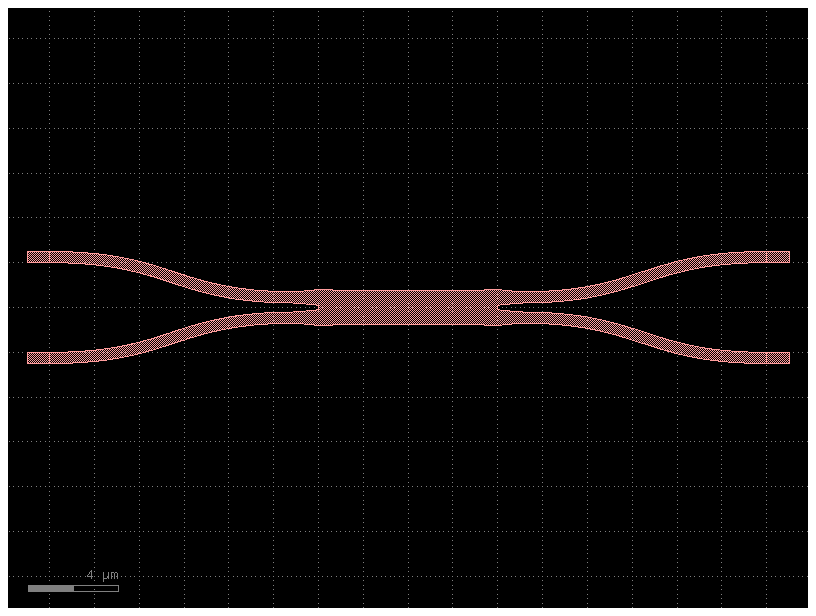
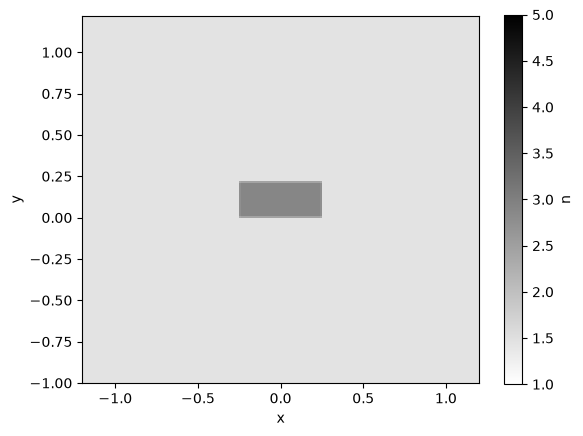
using simulation folder runs/mmi_nres6
========================================
backend using simulation folder runs/mmi_nres6
========================================
setting up simulation...
processing geometry bodies...
generating voxels...
voxelation: 10.125711 seconds (463.82 M allocations: 18.691 GiB, 25.67% gc time, 139.25% compilation time)
Yee mode λ=0.9935: neff 2.486
Yee mode λ=1.0: neff 2.4736
Yee mode λ=1.0065: neff 2.4611
making sources o1 ...
making monitors o1 o2 o3 o4 ...
========================================
run: runs/mmi_nres6
processor: GPU
cpu threads: 48

nres: 6.0
courant: 0.9
subpixel_smoothing: 1

boundaries: [:PML :PML; :PML :PML; :PML :PML]

sources
   o1: -13, -2.25, 0

monitors
   o1: -12, -2.25, 0
   o2: -12, 2.25, 0
   o3: 20, 2.25, 0
   o4: 20, -2.25, 0

original size: (460, 91, 26)
padded size: (511, 115, 42)
cell count: 2,468,130

step size: 29.0 steps/period
source duration: 3.93 periods

max time: 1,000 periods
max steps: 29,000
max load: 71,575,770,000 cell-steps
energy decay threshold: 0.001
========================================
running simulation...
accumulating dft field...
period 10, decay: 0.96, 1.49 seconds/period, 48.09 Mcells/s
period 20, decay: 0.95, 0.011 seconds/period, 6336.38 Mcells/s
period 30, decay: 0.94, 0.008 seconds/period, 9257.59 Mcells/s
period 40, decay: 0.92, 0.009 seconds/period, 7595.29 Mcells/s
period 50, decay: 0.92, 0.007 seconds/period, 9553.36 Mcells/s
period 60, decay: 0.91, 0.007 seconds/period, 9551.96 Mcells/s
period 70, decay: 0.88, 0.009 seconds/period, 7789.12 Mcells/s
period 80, decay: 0.78, 0.008 seconds/period, 9499.76 Mcells/s
period 90, decay: 0.73, 0.009 seconds/period, 7916.88 Mcells/s
period 100, decay: 0.54, 0.007 seconds/period, 9550.17 Mcells/s
period 110, decay: 0.086, 0.009 seconds/period, 8059.26 Mcells/s
period 120, decay: 0.013, 0.008 seconds/period, 9514.36 Mcells/s
period 130, decay: 0.007, 0.007 seconds/period, 9553.76 Mcells/s
period 140, decay: 0.006, 0.009 seconds/period, 7581.86 Mcells/s
period 150, decay: 0.005, 0.008 seconds/period, 9535.82 Mcells/s
period 160, decay: 0.004, 0.009 seconds/period, 7857.87 Mcells/s
period 170, decay: 0.004, 0.008 seconds/period, 9527.8 Mcells/s
period 180, decay: 0.003, 0.009 seconds/period, 7729.32 Mcells/s
period 190, decay: 0.002, 0.008 seconds/period, 9483.65 Mcells/s
period 198.62 stop on energy decay
8489.5 Mcells/s
simulation completed.
{'runtime': 126.59987044334412, 'gpu_GB': 1.2353515625, 'host_GB': 2.4572982788085938}
using simulation folder runs/mmi_nres10
========================================
backend using simulation folder runs/mmi_nres10
========================================
setting up simulation...
processing geometry bodies...
generating voxels...
voxelation: 26.456843 seconds (1.34 G allocations: 51.541 GiB, 33.84% gc time, 54.07% compilation time)
Yee mode λ=0.9935: neff 2.4648
Yee mode λ=1.0: neff 2.4531
Yee mode λ=1.0065: neff 2.4414
making sources o1 ...
making monitors o1 o2 o3 o4 ...
========================================
run: runs/mmi_nres10
processor: GPU
cpu threads: 48

nres: 10.0
courant: 0.9
subpixel_smoothing: 1

boundaries: [:PML :PML; :PML :PML; :PML :PML]

sources
   o1: -13, -2.25, 0

monitors
   o1: -12, -2.25, 0
   o2: -12, 2.25, 0
   o3: 20, 2.25, 0
   o4: 20, -2.25, 0

original size: (764, 150, 41)
padded size: (847, 188, 68)
cell count: 10,828,048

step size: 49.0 steps/period
source duration: 3.94 periods

max time: 1,000 periods
max steps: 49,000
max load: 530,574,352,000 cell-steps
energy decay threshold: 0.001
========================================
running simulation...
accumulating dft field...
period 10, decay: 0.97, 1.52 seconds/period, 348.74 Mcells/s
period 20, decay: 0.97, 0.063 seconds/period, 8482.85 Mcells/s
period 30, decay: 0.97, 0.061 seconds/period, 8715.58 Mcells/s
period 40, decay: 0.95, 0.058 seconds/period, 9194.97 Mcells/s
period 50, decay: 0.95, 0.056 seconds/period, 9395.75 Mcells/s
period 60, decay: 0.94, 0.056 seconds/period, 9398.1 Mcells/s
period 70, decay: 0.88, 0.057 seconds/period, 9381.88 Mcells/s
period 80, decay: 0.79, 0.056 seconds/period, 9402.88 Mcells/s
period 90, decay: 0.75, 0.056 seconds/period, 9453.09 Mcells/s
period 100, decay: 0.068, 0.056 seconds/period, 9465.8 Mcells/s
period 110, decay: 0.013, 0.056 seconds/period, 9461.36 Mcells/s
period 120, decay: 0.008, 0.058 seconds/period, 9112.88 Mcells/s
period 130, decay: 0.003, 0.057 seconds/period, 9330.39 Mcells/s
period 140, decay: 0.002, 0.057 seconds/period, 9270.53 Mcells/s
period 150, decay: 0.002, 0.057 seconds/period, 9294.58 Mcells/s
period 160, decay: 0.002, 0.057 seconds/period, 9293.24 Mcells/s
period 170, decay: 0.002, 0.057 seconds/period, 9274.17 Mcells/s
period 180, decay: 0.002, 0.057 seconds/period, 9293.57 Mcells/s
period 185.47 stop on energy decay
9241.58 Mcells/s
simulation completed.
{'runtime': 154.33912324905396, 'gpu_GB': 3.0791015625, 'host_GB': 3.585926055908203}
using simulation folder runs/mmi_nres15
========================================
backend using simulation folder runs/mmi_nres15
========================================
setting up simulation...
processing geometry bodies...
generating voxels...
voxelation: 41.084999 seconds (3.27 G allocations: 122.792 GiB, 31.09% gc time, 45.66% compilation time)
Yee mode λ=0.9935: neff 2.4591
Yee mode λ=1.0: neff 2.4477
Yee mode λ=1.0065: neff 2.4362
making sources o1 ...
making monitors o1 o2 o3 o4 ...
========================================
run: runs/mmi_nres15
processor: GPU
cpu threads: 48

nres: 15.0
courant: 0.9
subpixel_smoothing: 1

boundaries: [:PML :PML; :PML :PML; :PML :PML]

sources
   o1: -13, -2.25, 0

monitors
   o1: -12, -2.25, 0
   o2: -12, 2.25, 0
   o3: 20, 2.25, 0
   o4: 20, -2.25, 0

original size: (1144, 221, 59)
padded size: (1269, 275, 96)
cell count: 33,501,600

step size: 72.0 steps/period
source duration: 3.93 periods

max time: 1,000 periods
max steps: 72,000
max load: 2,412,115,200,000 cell-steps
energy decay threshold: 0.0001
========================================
running simulation...
accumulating dft field...
period 10, decay: 0.97, 1.7 seconds/period, 1420.95 Mcells/s
period 20, decay: 0.96, 0.327 seconds/period, 7371.5 Mcells/s
period 30, decay: 0.96, 0.324 seconds/period, 7450.92 Mcells/s
period 40, decay: 0.95, 0.305 seconds/period, 7900.88 Mcells/s
period 50, decay: 0.95, 0.306 seconds/period, 7873.52 Mcells/s
period 60, decay: 0.94, 0.306 seconds/period, 7882.27 Mcells/s
period 70, decay: 0.86, 0.304 seconds/period, 7928.49 Mcells/s
period 80, decay: 0.79, 0.304 seconds/period, 7928.53 Mcells/s
period 90, decay: 0.75, 0.306 seconds/period, 7876.55 Mcells/s
period 100, decay: 0.046, 0.306 seconds/period, 7880.9 Mcells/s
period 110, decay: 0.011, 0.304 seconds/period, 7929.97 Mcells/s
period 120, decay: 0.003, 0.304 seconds/period, 7927.91 Mcells/s
period 130, decay: 0.0, 0.306 seconds/period, 7878.0 Mcells/s
period 140, decay: 0.0, 0.304 seconds/period, 7929.28 Mcells/s
period 144 stop on energy decay
7826.55 Mcells/s
simulation completed.
{'runtime': 205.23535656929016, 'gpu_GB': 9.7978515625, 'host_GB': 4.730339050292969}
Results
wls = np.array(wavelengths)
i = np.argmin(abs(wls - wavelength))
rows = []
fig, ax = plt.subplots(1, 2, figsize=(10, 4))
for nres in [6, 10, 15]:
    path = os.path.join("runs", f"mmi_nres{nres}")
    if not os.path.exists(os.path.join(path, "solution.json")):
        continue
    m = lumi.load(path)["monitors"]
    a1 = m["o1"]["modes"][0]["-"]
    T3 = np.abs(m["o3"]["modes"][0]["+"] / a1) ** 2  # cross
    T4 = np.abs(m["o4"]["modes"][0]["+"] / a1) ** 2  # through
    loss = -10 * np.log10(T3 + T4)
    f = os.path.join(path, "stats.json")
    st = json.load(open(f)) if os.path.exists(f) else {}
    rows.append((nres, T3[i], T4[i], loss[i], st.get("runtime"), st.get("gpu_GB"), st.get("host_GB")))
    ax[0].plot(wls, T3, label=f"nres {nres}")
    ax[1].plot(wls, loss, label=f"nres {nres}")

fmt = lambda v, f: "–" if v is None else format(v, f)
print("nres  cross T  through T  excess loss  runtime  GPU mem  host mem")
for nres, t3, t4, l, rt, g, h in rows:
    print(f"{nres:4d}  {100*t3:6.1f} %  {100*t4:7.1f} %  {l:8.3f} dB  {fmt(rt, '5.0f'):>5} s  {fmt(g, '5.2f'):>5} GB  {fmt(h, '5.2f'):>5} GB")

ax[0].set(xlabel="wavelength [um]", ylabel="cross transmittance")
ax[1].set(xlabel="wavelength [um]", ylabel="excess loss [dB]")
ax[0].legend()
plt.tight_layout()
plt.show()
loading solution from runs/mmi_nres6
may take a minute if simulation folder is remotely mounted
loading solution from runs/mmi_nres10
may take a minute if simulation folder is remotely mounted
loading solution from runs/mmi_nres15
may take a minute if simulation folder is remotely mounted
nres cross T through T excess loss runtime GPU mem host mem
6 35.3 % 47.0 % 0.843 dB 127 s 1.24 GB 2.46 GB
10 45.7 % 49.2 % 0.227 dB 154 s 3.08 GB 3.59 GB
15 47.6 % 48.4 % 0.177 dB 205 s 9.80 GB 4.73 GB
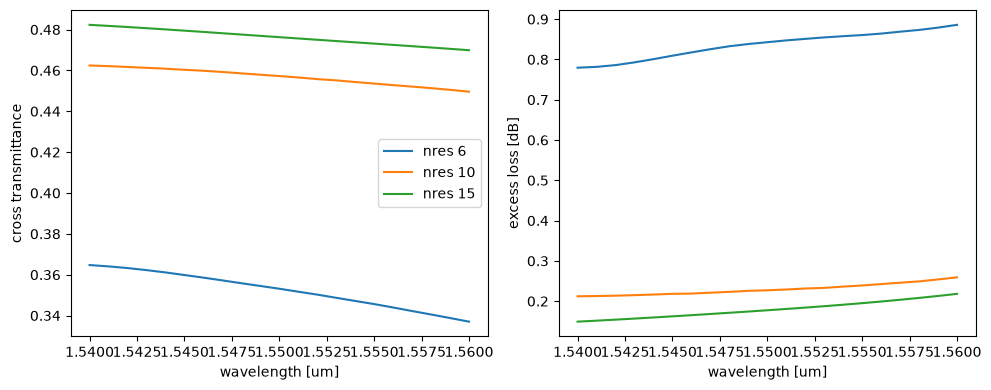
Fig. 12a comparison
# paper Fig. 12a, digitized
nres_paper = [6, 10, 15, 20, 25]
T_tidy3d = [0.357, 0.461, 0.479, 0.485, 0.489]
T_lumerical = [0.376, 0.459, 0.483, 0.487, 0.489]

plt.figure(figsize=(5, 3.5))
plt.plot(nres_paper, T_lumerical, "o-", color="red", label="Lumerical")
plt.plot(nres_paper, T_tidy3d, "o-", color="blue", label="Tidy3D")
plt.plot([r[0] for r in rows], [r[1] for r in rows], "o-", color="black", label="Luminescent")
plt.xlabel("nres (cells per wavelength)")
plt.ylabel("transmission")
plt.title("Cross port TE0 at 1550 nm")
plt.grid(alpha=0.3)
plt.legend()
plt.show()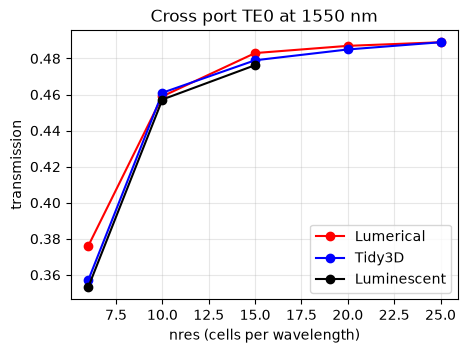
Movie
nres_list = [6]